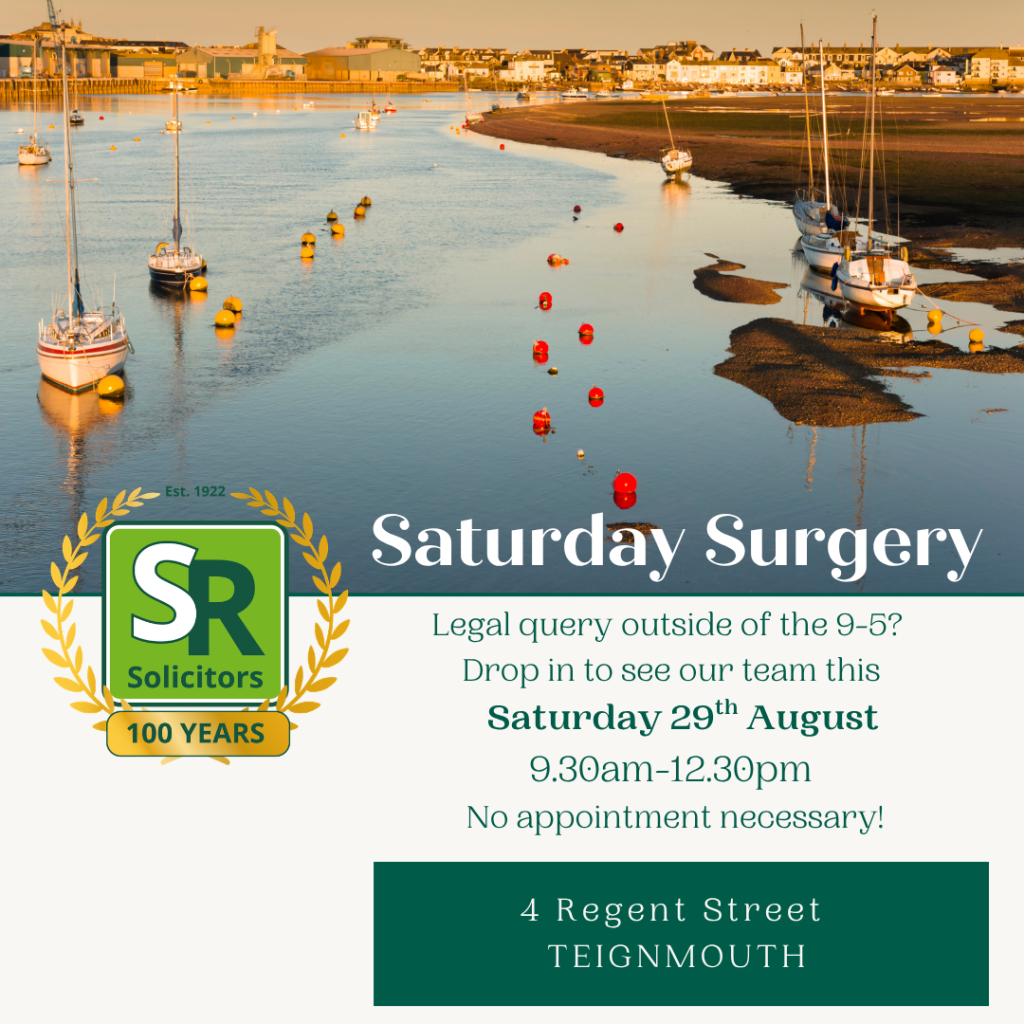
Please note that our offices will be closed on Monday 31st August in observance of the Bank Holiday.
We would like to remind clients that our Saturday Surgery will still be taking place on Saturday 29th August, providing an opportunity to speak with a member of our legal team before the Bank Holiday closure.
Our offices will reopen on Tuesday 1st September, when normal business hours will resume.
We wish all our clients and contacts a pleasant Bank Holiday weekend.
We’re delighted to have recently presented a donation to Dawlish Community Transport, raised through our monthly Dress Down Fridays.
Pictured are Jerry from Dawlish Community Transport collecting the donation from our colleagues, Receptionist, Linda Rogers and Private Client Assistant, Mandy Johnson, on behalf of the charity.
At Scott Richards, we’re proud to support organisations that make a real difference in our local community, and Dawlish Community Transport is a fantastic example of that.
Dawlish Community Transport is a local registered charity that provides accessible and affordable transport for people who may be unable to use public transport, including those with mobility difficulties and wheelchair users. Their services help local residents access essential appointments, shopping trips, community activities and social outings, promoting independence and reducing social isolation. The charity operates a fleet of adapted vehicles and relies heavily on the dedication of its volunteers to keep people connected across Dawlish and the surrounding areas.
In addition to its door-to-door transport services, the charity also runs community bus routes and wellbeing trips, helping people stay active, independent and engaged with their local community.
A huge thank you to our staff for raising these funds. We’re pleased to know the donation will help keep the wheels turning for such a valued local charity.
To find out more about Dawlish Community Transport and the services they provide, visit their website: https://dawlish-mobility.co.uk/.
The Government is currently consulting on possible changes to the law for cohabiting couples in England and Wales. The consultation, A Fairer End to Relationships, opened on 5 June 2026 and closes at 11:59pm on 14 August 2026.
At present, cohabiting couples have far fewer legal rights than couples who are married or in a civil partnership. This often comes as a surprise, particularly where a couple has lived together for many years, shared finances or raised children together.
If the proposed reforms are introduced, they could represent a significant shift in the legal protection available to many cohabiting couples and their families.
The Government has recognised that more than 3.5 million couples live together without marrying or entering into a civil partnership. It is considering a new statutory framework that would give eligible cohabitants certain financial rights and protections when a relationship ends. The proposed scheme would be narrower than the financial remedies available on divorce, so marriage and civil partnership would retain their distinct legal status. However, the reforms are intended to give greater protection to people who may otherwise be financially vulnerable, including those who have made caring or non-financial contributions during the relationship.
Cohabitation and intestacy (dying without a Will)
The consultation also looks at whether the law should change so that qualifying cohabitants may have inheritance rights if their partner dies without leaving a valid will. At the moment, cohabiting partners do not automatically inherit under the intestacy rules, which can leave a surviving partner in a very difficult financial position.
Key themes in the consultation
The consultation is guided by four broad principles:
prioritising fair outcomes for children;
protecting vulnerable individuals, including survivors of domestic abuse;
creating a clearer and more accessible legal framework; and
preserving the distinct legal status of marriage.
The proposed cohabitation scheme would apply to adults in long-term, committed and interdependent relationships. This may include couples who have lived together for three or more years, or couples who live together and have a child. The starting point would remain that each person keeps what they legally own. The court would only depart from that position where it is necessary to meet defined needs. Any awards would be more limited than those available on divorce, and a clean break would be encouraged wherever possible.
The proposed intestacy reforms would allow qualifying cohabitants to inherit automatically in certain circumstances where their partner dies without a valid will. The consultation also considers whether qualifying cohabitants should have rights to administer their partner’s estate, and whether time limits should be changed for some claims involving children.
The current law
Cohabitation is when a couple lives together without being married or in a civil partnership. It is the fastest-growing family type in England and Wales, but the law has not developed in the same way as it has for married couples and civil partners. As a result, the legal position for unmarried couples can be limited, complex and often misunderstood.
The myth of “common law marriage”
Many people believe that a couple who has lived together for a long time will automatically acquire similar rights to a married couple. This is often referred to as “common law marriage”. In England and Wales, common law marriage does not exist. No matter how long a couple has lived together, they are treated in law as two separate individuals unless they are married or in a civil partnership.
Key legal issues for cohabiting couples
Property ownership
Property disputes are one of the most common issues when cohabiting couples separate. In general, legal ownership depends on whose name is on the title deeds. A partner who is not named as an owner may need to rely on complex trust law arguments to establish an interest in the property. Contributions to the mortgage, bills or household expenses do not automatically create a legal share.
Financial claims on separation
Unlike married couples, cohabiting partners do not have an automatic right to financial support or maintenance after separation. There is also no general legal framework for dividing assets fairly. In most cases, each person keeps the assets in their own name unless a claim can be established through property or trust law.
Pensions and inheritance
Cohabiting partners have no automatic right to inherit if one partner dies without a valid will. They also do not have automatic rights to pension sharing or survivor benefits in the same way as married couples or civil partners. Without proper planning, a surviving partner may receive little or nothing.
Children
The law treats children separately from financial disputes between adults. Both parents may have financial responsibilities towards their children, and claims can sometimes be made under Schedule 1 of the Children Act 1989 for housing or financial provision. However, these claims are for the benefit of the child, not the former partner personally.
Cohabitation agreements: a practical solution
Because the current legal protection is limited, a cohabitation agreement can be an important way of reducing uncertainty and avoiding disputes.
A cohabitation agreement is a legally binding document that records how a couple intends to manage their finances and property during the relationship and if they later separate. It can cover issues such as ownership of property, contributions to mortgage or rent, responsibility for bills and debts, division of assets, and arrangements for jointly owned possessions.
Ideally, both parties should take independent legal advice before entering into the agreement. They should also provide full and honest financial disclosure and enter into the agreement freely.
Other protective steps
Couples who live together should also consider putting other arrangements in place, including:
a declaration of trust to record property shares;
wills to make clear who should inherit;
life insurance for financial security; and
careful consideration of whether property should be owned as joint tenants or tenants in common.
Practical advice
If you are moving in with a partner, buying a property together or making significant financial contributions to a home you do not own, it is sensible to take legal advice at an early stage. Clear written arrangements can help avoid misunderstandings and reduce the risk of costly disputes later.
Conclusion
Cohabiting couples in England and Wales currently have significantly less legal protection than married couples or civil partners. The Government’s consultation may lead to important changes, but for now proactive planning remains essential. Cohabitation agreements, wills and clear property documentation can all help protect both partners and reduce the risk of future disputes.
Need advice?
If you would like to discuss your situation or put a cohabitation agreement in place, please get in touch. Early advice can make a significant difference. Contact our Family Team on: 01626 772 441 or law@scottrichards.co.uk
We are delighted to share that our Senior Partner, Paul Dyson, was personally invited to attend the Middlesex & Hertfordshire Branch of the British Dental Association’s Annual Presidential & Scientific Meeting, which this year, took place in Riga, the capital and largest city in Latvia.
Pictured: The City of Riga, Latvia
The event brings together people from across the dental profession for a few days of discussion, networking and shared learning. For Paul, the invitation was a welcome recognition of his long-standing work with dentists and dental practices in the Middlesex and Hertfordshire area.
Paul is a commercial and commercial property lawyer with a speciality and keen interest in dental legal work. He acts for dentists across the country, from associates and small clinics to larger dental practices, and regularly advises on the sale and purchase of dental practices involving both freehold and leasehold premises. His work includes transactions for private, NHS and mixed practices.
Paul and his team understand how dental practices work and the commercial pressures they face. He is familiar with NHS Contracts and he supports private practices, including those operating on a “pay as you go” basis or through capitation schemes. He is familiar with the regulatory and practical challenges dentists deal with every day, whether that be with the Care Quality Commission, staffing matters or otherwise.
Paul’s personal invitation to the 71st Middlesex & Hertfordshire’s Branch of the British Dental Association’s Annual Presidential & Scientific Meeting is something as a firm, we are very proud of, and reflects the trust and experience Paul has built within the dental profession for more than 20 years.
The weekend also served as a fitting tribute to Nikki Davey, the elected Branch President for the year, whose untimely passing following a courageous battle with cancer was deeply felt by all who knew her. True to her character, Nikki had insisted that “the show must go on” and that the event should proceed at her chosen venue of Riga. For Paul, the occasion carried particular significance. Almost 20 years ago, Nikki became the first member of the Branch to instruct him when she sold her dental practice. That relationship led to further introductions and referrals, enabling Paul to build long-standing professional relationships with many dentists across the Branch. Over the years, those connections have also resulted in Scott Richards Solicitors supporting not only dental professionals but also their families and friends with a wide range of legal matters. Being invited to attend the event in Riga was therefore especially meaningful for Paul, providing an opportunity to honour Nikki’s memory and reflect on the relationships and trust that she helped establish.
A busy few days in Riga
Paul was joined by his wife, Gaye Dyson, for a packed programme of professional events, sightseeing and celebrations. The weekend began on the Thursday evening with the traditional Welcome Drinks Reception, which Scott Richards Solicitors was proud to sponsor.
On Friday, delegates spent the day visiting Rundāle Palace in the Zemgale region, followed by a visit to a brewery. It was a chance to see more of Latvia beyond Riga and enjoy one of the country’s most impressive historic landmarks.
Pictured: Rundāle Palace
Paul commented that Rundāle Palace was spectacular and reminded him and Gaye of the Hermitage Palace in St Petersburg, which they had visited ten years earlier. He added that the brewery visit provided a lovely cultural contrast, and that the beer samples were superb!
Saturday morning was spent exploring Riga by foot and by bus. The tour included the city’s Art Nouveau, or Jugendstil, district and the famous Alberta iela, as well as the UNESCO World Heritage Old Town, the Freedom Monument, Dome Square, the House of the Blackheads and the Central Market.
Paul and Gaye were particularly impressed by the architecture of the various buildings and gained a deeper understanding of the Russian occupation, especially during the Cold War period following the Second World War. Their tour guide was extremely knowledgeable and brought a personal perspective to the experience; having been born in Riga, she was able to share first-hand insights into life during those years, adding a valuable human dimension to the historical narrative.
Pictured: Paul and others in the mini group engrossed in the tour guide’s words at the KGB museum. Tour guide (purple coat) takes Paul and Gaye (far right) and group around the historic streets of Riga on the Saturday morning.
The highlight of the weekend came on Saturday evening, with the Presidential Drinks Reception followed by the Gala Dinner. The evening also included the unique Loving Cup ceremony, a fundraising raffle for the Benevolent Fund, and the induction of Louise Conway as the new President of the Branch.
Paul and Gaye were delighted to be toasted on several occasions throughout the evening, with tributes paid to Paul and Scott Richards in recognition of the legal assistance they had provided over the years to many of the members. Thanks were also extended to Scott Richards for sponsoring the drinks reception on the opening night.
Sunday was left free for delegates to further explore Riga or simply relax and recover after the celebrations. Paul and Gaye, together with a small group of fellow delegates, chose to visit the KGB Museum before enjoying cocktails at a rooftop bar overlooking the city—a striking contrast to the morning’s historical experience. As Latvia only regained its independence from Soviet rule in 1991, signs of Russian influence remained evident throughout Riga. Gaye reflected that she was “particularly struck by the harrowing accounts of living conditions and executions depicted in the KGB Museum,” which provided a powerful insight into this difficult period of the country’s history.
The 71st Presidential and Scientific Meeting then concluded on Monday morning with the final Scientific Meeting, featuring guest speaker Assistant Professor Dr Ilze Maldupa from Riga Stradiņš University.
It was a memorable few days and a real honour for Paul to be part of such a special event in the Branch calendar. We look forward to continuing our close work with dental professionals and supporting them with practical, specialist legal advice.
Pictured: Senior Partner, Paul Dyson & one of the Latvian hosts. Pictured: Paul Dyson (centre) talking to members and guests at the pre-Gala Dinner drinks on the Saturday eveningPictured: Gaye Dyson (far right) at the pre-Gala Dinner drinks on Saturday eveningPictured: Paul Dyson (far left), Branch President Elect, Louise Conway (in blue) Pictured: Paul Dyson (centre) being welcomed, introduced and thanked at the Thursday evening drinks Reception by Master of Ceremonies (and Scott Richards client), Jonathan Randall (left)
Pre-Nuptial and Post-Nuptial Agreements: Do I really need one?
Many people ask whether these agreements are worth having.
The simple answer is: if you have assets you want to protect that you owned before the relationship or marriage, then yes – a nuptial agreement can be highly beneficial.
At Scott Richards, our family team specialises in providing straightforward and reliable advice. We are happy to discuss your circumstances and advise and assist you in achieving the best outcome for you.
Set out below is a short practical guide.
Pre-nuptial (“pre-nup”) and post-nuptial (“post-nup”) agreements are legal documents that set out how a couple’s finances and assets should be dealt with if their relationship breaks down. While often associated with wealth protection, they are increasingly used by couples seeking clarity, certainty, and fairness.
What is a Pre-Nuptial Agreement?
A pre-nuptial agreement is entered into before marriage or civil partnership. It typically records how assets, income, pensions, and liabilities will be divided in the event of separation or divorce.
What is a Post-Nuptial Agreement?
A post-nuptial agreement is made during the marriage or civil partnership. Couples may choose to enter into one following a significant life event, such as having a child, receiving an inheritance, starting a business, or experiencing difficulties in the relationship.
Are they legally binding?
In England and Wales, nuptial agreements are not automatically legally binding. However, the courts will usually give them significant weight if certain safeguards are met, particularly following the landmark case of Radmacher v Granatino.
For an agreement to carry weight, it should be:
– Freely entered into by both parties – Based on full and frank financial disclosure – Supported by independent legal advice for each party – Fair in its outcome, particularly in meeting the needs of the parties and any children
Why consider a Nuptial Agreement?
– To protect pre-acquired or inherited wealth – To safeguard business interests – To provide clarity and reduce conflict in the event of separation
– To protect children from previous relationships – To record agreed financial arrangements, particularly in second marriages
Key Considerations
The court’s primary concern will always be fairness. Agreements cannot override the obligation to meet financial needs, especially where children are involved. Regular review is advisable, particularly if circumstances change.
Conclusion
Pre- and post-nuptial agreements are valuable tools in modern family law. While they cannot entirely remove the court’s discretion, a properly prepared agreement can offer reassurance, transparency, and a strong framework for resolving financial matters if a relationship ends. It is not about expecting a marriage to fail; rather, it is about providing clarity, transparency, and financial security for the future. A carefully prepared agreement can help couples have open discussions about finances, protect assets and family interests, and reduce the potential for costly disputes if the relationship later breaks down. When entered into fairly, with full disclosure and independent legal advice, a pre-nuptial agreement can provide reassurance and certainty for both parties as they begin married life together.
So, if you intend to marry or enter into a civil partnership, it may be a sensible decision to put a pre-nuptial agreement in place.
If you are considering a nuptial agreement, seeking early legal advice is essential to ensure the document is robust and tailored to your particular circumstances.
Separation Agreement vs Divorce: A Straightforward Guide
When a relationship breaks down, choosing the right path forward can feel overwhelming. At a time of uncertainty, clients often tell us that they want clear answers and reliable guidance. Whether you are considering a separation agreement or a divorce, understanding the differences can help you make an informed decision that feels right for you.
SEPARATION AGREEMENTS
A separation agreement is a written contract between spouses that sets out how financial and practical matters will be managed while you live apart. It does not legally end the marriage, but it can provide structure and guidance during a period of transition.
Merits
A separation agreement is a flexible and practical option for couples who wish to live apart without legally ending their marriage. A separation agreement offers flexibility for clients who seek interim arrangements whilst they take time to decide what is the right next step for them. It offers clarity by setting out how finances and property‑related arrangements will be managed during the separation, helping to reduce uncertainty at what is often a difficult time. Due to separation agreements being achievable through negotiation or mediation, it is typically quicker and less formal than court proceedings. While not legally binding in the same way as a court order, such as a Financial Consent Order, a well‑drafted agreement supported by legal advice and full financial disclosure can carry significant weight if matters later progress to divorce, making it a useful foundation for future arrangements.
Drawbacks
A separation agreement does have limitations, the most significant being that it is not concretely legally binding, meaning a court may depart from its terms if it considers them unfair or if circumstances have changed. Because the marriage legally continues, it also cannot provide a final financial clean break, leaving both spouses able to bring financial claims against one another in the future. In addition, there is potential for further disputes, as either party may later challenge or disagree with the agreement, which could lead to renewed negotiations or the need for court involvement.
It is prudent to note that a separation agreement cannot conclusively deal with pension arrangements. Pension sharing orders, which are the mechanism required to formally divide pension assets, can only be made once divorce proceedings have been issued. As a result, postponing pension matters can carry significant risks, particularly where pensions form a substantial part of the matrimonial finances, as delaying may leave individuals without the long‑term security that a court-approved Financial Consent Order provides.
DIVORCE
A divorce is the legal process that ends a marriage. The no‑fault system now in place in England and Wales makes the process more straightforward, with no need to attach blame to either party.
Merits
A divorce offers a clear, final and legal end to the marriage, providing certainty and allowing both individuals to move forward independently, both financially and emotionally. It enables couples to secure enforceable financial orders, such as a court‑approved Financial Consent Order dealing with property, pensions, maintenance and other financial matters, giving long‑term legal certainty. Divorce can also allow for a clean financial break, preventing future claims between spouses and offering both parties long‑term security. By removing all remaining legal and financial ties, divorce supports effective long‑term planning, helping each person move on with clarity, independence and confidence.
A divorce is additionally the most effective route for dealing with pensions, as it enables the court to make legally binding pension sharing orders. These orders allow pension assets to be divided fairly and with certainty, providing clarity and long‑term security for both parties. By finalising pension arrangements within the divorce process, individuals can ensure that this significant element of the matrimonial finances is dealt with comprehensively, avoiding the risks and uncertainty that can arise if pension matters are left unresolved.
Drawbacks
A divorce can have drawbacks, the most notable being that it generally takes longer than a separation agreement, as mandatory waiting periods between the application for a divorce, your conditional order being granted and applying for the final order means the divorce process typically lasts around seven to nine months and frequently longer where finances need to be finalised. For many, the emotional finality of legally ending the marriage can also feel more challenging than entering into a temporary arrangement, such as a separation agreement. In addition, divorce can involve higher costs, particularly where financial matters are complex or contested, which may require more extensive legal involvement.
WHICH OPTION IS RIGHT FOR YOU?
At Scott Richards, we believe in giving clients clear, reliable and straightforward advice, tailored to their individual circumstances.
Choosing between a separation agreement and a divorce is a deeply personal decision, and the right choice will depend on your circumstances, your priorities, and the pace at which you feel ready to move forward. A separation agreement can offer clarity, flexibility and stability in the short-to-medium-term without the finality of legally ending the marriage, making it a practical option for those who need time and space to adjust to living apart from their spouse. Divorce, on the other hand, provides a definitive legal end to the relationship, allowing for binding financial orders and the certainty of a clean break, kickstarting your independence.
Both routes have clear advantages, and both come with limitations. What matters most is understanding which path aligns with your needs, whether that is flexibility during a period of change or the confidence that all financial and legal ties have been resolved.
Whenever you feel ready, the Family team at Scott Richards are here to offer straightforward and reliable advice, guiding you through each step with clarity and care. Whether you choose a separation agreement or decide that divorce is the right way forward, we will be happy to assist you in achieving the outcome that feels right for you.
We’re pleased to welcome Jessica Burgess to the team. In this video, Jessica introduces herself and explains the work she specialises in and how she helps support our clients on a day‑to‑day basis.
Taking Children Abroad: Key Family Law Considerations for Parents
Are you looking forward to a holiday and planning to take your child or children abroad?
If so, this article may be of interest to you—particularly if you are separated or divorced.
For many parents, taking a child abroad, even for a short holiday, can raise important legal issues. Misunderstandings or failure to obtain the proper consent can lead to serious consequences, including allegations of child abduction. This guide sets out the key points every parent should understand before travelling abroad with a child.
Do You Need Consent to Take a Child Abroad?
In most cases, yes.
Where more than one person has parental responsibility, you must obtain the consent of everyone with parental responsibility before taking a child out of the UK, even for a holiday.
Parental responsibility may include:
Mothers (automatically)
Fathers (if married to the mother at the time of birth, or named on the birth certificate, depending on timing)
Anyone with parental responsibility through:
A court order
A parental responsibility agreement
In some cases, the local authority
Exception: Child Arrangements Orders
If you have a Child Arrangements Order stating that the child “lives with” you, you may take the child abroad for up to 28 days without the other parent’s consent, unless the order says otherwise.
Even where consent is not legally required, it is still good practice to:
Inform the other parent in advance
Provide travel dates and destination details
Share accommodation details
Where appropriate, agree reasonable contact arrangements while the child is away
What Happens If Consent Is Not Obtained?
Taking a child abroad without the required consent may amount to:
Child abduction under the Child Abduction Act 1984
A breach of court orders, where an order is in place
This applies even if:
You are the child’s primary carer
The trip is temporary, such as a holiday
The consequences can be both civil and criminal and may also have a significant impact on future court proceedings.
What If the Other Parent Refuses Consent?
If consent is unreasonably refused or cannot be obtained, you must apply to the court for permission before travelling.
This is usually done by applying for a Specific Issue Order, asking the court to allow the trip.
When deciding the application, the court will consider:
The purpose and duration of the trip
The child’s welfare
Any risk of the child not being returned
How contact with the other parent will be maintained
Genuine holidays are rarely refused, provided there is no real risk of non-return.
Practical Steps Before Travelling
To avoid disputes or complications, consider the following steps:
1. Obtain Written Consent
A signed letter from the other parent confirming:
Their agreement to the trip
The travel dates
The destination
2. Carry Supporting Documents
You may be asked to produce evidence while travelling. Useful documents include:
The child’s birth certificate
The consent letter
A copy of any relevant court order
3. Share Full Travel Details
Provide the other parent with:
Flight details
Accommodation information
Emergency contact details
4. Check Destination Requirements
Some countries have strict entry requirements for children travelling with one parent. It is essential to check and comply with any applicable rules for your destination.
When Should You Seek Legal Advice?
You should seek legal advice if:
The other parent refuses consent
There is a history of conflict or court proceedings
You are concerned the other parent may not return the child
You are planning a longer stay or permanent relocation
Early legal advice can prevent disputes and help ensure your plans proceed lawfully.
Conclusion
Taking a child abroad is usually straightforward where parents cooperate. However, the legal requirements are strict, and failing to follow them can have serious consequences. Obtaining consent, communicating clearly, and understanding your legal position are essential for a smooth and stress-free holiday.
If you are unsure, our Family team can provide clear advice and, where necessary, assist you in ensuring your holiday plans run smoothly and within the law. You can contact our team, here.
We use cookies to analyse our traffic and share information about your use of our site with our social media, advertising and analytics partners. View more
Cookies settings
Accept
Reject
Privacy & Cookie policy
Privacy & Cookies policy
Cookies list
Cookie name
Active
Who we are
Our website address is: https://www.scottrichards.co.uk.
What personal data we collect and why we collect it
Comments
When visitors leave comments on the site we collect the data shown in the comments form, and also the visitor's IP address and browser user agent string to help spam detection.
An anonymized string created from your email address (also called a hash) may be provided to the Gravatar service to see if you are using it. The Gravatar service privacy policy is available here: https://automattic.com/privacy/. After approval of your comment, your profile picture is visible to the public in the context of your comment.
Media
If you upload images to the website, you should avoid uploading images with embedded location data (EXIF GPS) included. Visitors to the website can download and extract any location data from images on the website.
Contact forms
Cookies
If you leave a comment on our site you may opt-in to saving your name, email address and website in cookies. These are for your convenience so that you do not have to fill in your details again when you leave another comment. These cookies will last for one year.
If you visit our login page, we will set a temporary cookie to determine if your browser accepts cookies. This cookie contains no personal data and is discarded when you close your browser.
When you log in, we will also set up several cookies to save your login information and your screen display choices. Login cookies last for two days, and screen options cookies last for a year. If you select "Remember Me", your login will persist for two weeks. If you log out of your account, the login cookies will be removed.
If you edit or publish an article, an additional cookie will be saved in your browser. This cookie includes no personal data and simply indicates the post ID of the article you just edited. It expires after 1 day.
Embedded content from other websites
Articles on this site may include embedded content (e.g. videos, images, articles, etc.). Embedded content from other websites behaves in the exact same way as if the visitor has visited the other website.
These websites may collect data about you, use cookies, embed additional third-party tracking, and monitor your interaction with that embedded content, including tracking your interaction with the embedded content if you have an account and are logged in to that website.
Analytics
Who we share your data with
How long we retain your data
If you leave a comment, the comment and its metadata are retained indefinitely. This is so we can recognize and approve any follow-up comments automatically instead of holding them in a moderation queue.
For users that register on our website (if any), we also store the personal information they provide in their user profile. All users can see, edit, or delete their personal information at any time (except they cannot change their username). Website administrators can also see and edit that information.
What rights you have over your data
If you have an account on this site, or have left comments, you can request to receive an exported file of the personal data we hold about you, including any data you have provided to us. You can also request that we erase any personal data we hold about you. This does not include any data we are obliged to keep for administrative, legal, or security purposes.
Where we send your data
Visitor comments may be checked through an automated spam detection service.
Your contact information
Additional information
How we protect your data
What data breach procedures we have in place
What third parties we receive data from
What automated decision making and/or profiling we do with user data